-- Posted Thursday, 26 January 2012 | | Disqus
Northern Gold Mining Inc. (TSX-V: NGM) today released assay results for six additional diamond drill holes, totalling 2,368 metres of drilling, from its 2011 exploration program at the Garrcon deposit, which is located on the 100-per-cent-owned Garrison gold property, 100 kilometres east of Timmins, Ont.
Highlights reported here from the 2011 program:
from infill holes within the resource footprint:
-- 1.0 meters of 84.3 g/tonne
-- 1.0 meters of 64.5 g/tonne
-- 150.6 meters of 1.24 g/tonne
From stepout holes east of the resource footprint:
-- 54.0 meters of 1.18 g/tonne
-- 13.3 meters of 4.36 g/tonne
-- 0.7 meters of 35.96 g/tonne
As part of the 2011 exploration drill program on the Garrcon Deposit, assay results have been received from three more vertical drill holes (GAR-11-113, GAR-11-114 and GAR-11- 115) located in the southern half of the resource footprint established in the NI 43-101 Technical Report by A.C.A. Howe International Limited ("Howe Report") and filed on SEDAR August 8, 2011. These holes were drilled along section line 10+50 W, once again identifying long, up to 421 meters, downhole lengths of gold mineralization above the Howe Report's cutoff grade of 0.3 g/tonne.
Assay results received from the three stepout holes, GAR-11-130, GAR-11-140, and GAR- 11-141, east of the Howe Report's resource footprint, extend the known strike length of the Garrcon mineralized deposit another 200 meters eastwards, increasing the length of known mineralization to 1 km. The best intersection in these three holes is 54 meters of 1.16 g/tonne Au. In addition, higher grades were intersected over shorter lengths of downhole mineralization in all three stepout holes.
"Early results from the stepout drilling east of the Howe resource footprint are very exciting to us as they appear to be in similar mineralization to that seen within the NI 43-101 resource", said Martin Shefsky, President and CEO of Northern Gold Mining Inc. "The mineralization reported within the resource and that seen in the stepout drill holes continue to support the potential of the Garrcon geologic model as a large, bulk mineable, open pit deposit."
The significant composite assay intervals in the six holes are outlined below in Table 1.
Table 1 - Assay Results(i)
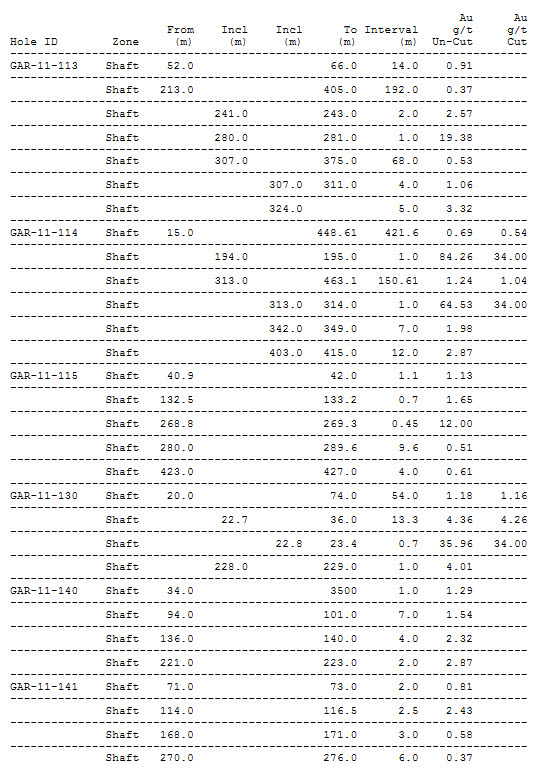
(i)True widths are not known because mineralization occurs as multi-directional stockwork veining; therefore, all assay intervals are downhole intervals and not true widths.
Complete details of these holes in both cross-section and plan can be viewed on the Company's website at: http://www.northerngold.ca/files/Garrcon-Cross_Sections.pdf
Table 2 - Location and Orientation of Drill Holes
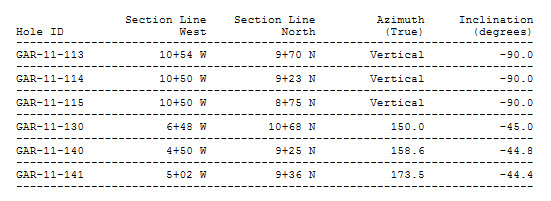
Drill hole GAR-11-115 is a vertical hole that encountered lamprophyre dike for most of its 462 meters to final length. Where the hole encountered metasediments gold grades above 0.3 g/t were intersected over short intervals, but within the lamprophyre grades were either less than 0.05 g/t with numerous assays below the assay detection limit of 0.005 g/t. The Garrcon Deposit remains open on strike to the east and west, to depth and toward the Jonpol East Zone on the north.
Quality Control / Quality Assurance
Northern Gold follows comprehensive, industry standard QA/QC protocols dealing with drilling, core recovery and handling, sampling and assaying. Detailed information about these protocols can be viewed on the Company's website at: http://www.northerngold.ca/QA-QC.php.
CAUTIONARY STATEMENT: Neither TSX Venture Exchange nor its Regulation Services Provider (as that term is defined in the policies of the TSX Venture Exchange) accepts responsibility for the adequacy or accuracy of this release. This News Release includes certain "forward-looking statements." These statements are based on information currently available to the Company and the Company provides no assurance that actual results will meet management's expectations. Forward-looking statements include estimates and statements that describe the Company's future plans, objectives or goals, including words to the effect that the Company or management expects a stated condition or result to occur. Forward-looking statements may be identified by such terms as "believes", "anticipates", "expects", "estimates", "may", "could", "would", "will", or "plan". Since forward-looking statements are based on assumptions and address future events and conditions, by their very nature they involve inherent risks and uncertainties. Actual results relating to, among other things, results of exploration, project development, reclamation and capital costs of the Company's mineral properties, and the Company's financial condition and prospects, could differ materially from those currently anticipated in such statements for many reasons such as: changes in general economic conditions and conditions in the financial markets; changes in demand and prices for minerals; litigation, legislative, environmental and other judicial, regulatory, political and competitive developments; technological and operational difficulties encountered in connection with the activities of the Company; and other matters discussed in this news release. This list is not exhaustive of the factors that may affect any of the Company's forward-looking statements. These and other factors should be considered carefully and readers should not place undue reliance on the Company's forward-looking statements. The Company does not undertake to update any forward-looking statement that may be made from time to time by the Company or on its behalf, except in accordance with applicable securities laws.
-- Posted Thursday, 26 January 2012 | Digg This Article | Source: GoldSeek.com


