Advertise | Bookmark | Contact Us | E-Mail List |  | Update Page | UraniumSeek.com 

Commentary : Gold Stock Review : Markets : News Wire : Quotes : Radio : Silver : Stocks - Main 
  
 GoldSeek.com >> News >> Story

 Disclaimer 

Latest Headlines


Gold Seeker Weekly Wrap-Up: Gold and Silver Gain Again on the Week
By: Chris Mullen, Gold-Seeker.com

COT Gold, Silver and US Dollar Index Report - May 16, 2008
By: GoldSeek.com

Gold, What Gold?
By: David Galland, Managing Director, Casey Research, LLC

Beta Beats Alpha
By: Bill Bonner & The Daily Reckoning Crew

China's Simple Solution
By: Peter Schiff, Euro Pacific Capital, Inc.

Inflate Away Debt? Three Lessons from History
By: Adrian Ash, BullionVault

Money Inflation
By: Adam Hamilton, Zeal Intelligence LLC

GREEN GOLD: The Highest-Profit-Potential, Lowest-Recession-Risk, Sector?
By: Deepcaster

A Further Warning to the CFTC!
By: Jason Hommel, Silver Stock Report

The Myth of Lower Oil Prices
By: Ty Andros, TraderView


Search

GoldSeek Web


The Coming Flight to Gold


-- Posted Tuesday, 28 August 2007 | Digg This ArticleDigg It!


Panic has seized the minds of many as the shaking of a credit implosion rumbles through the marketplaces of today’s moneychangers. The ground is giving way beneath them threatening to suck them into a financial hell of derivative defaults and dishonored debts. The penalty is eternal death for hedge funds doomed never to rise again whilst for others they escape those searing flames by the skin of their solvent teeth.


For those scrambling away from this mighty cave-in of debt, to whom do they run to for refuge? The answer paradoxically is to a place which itself seems on shaky foundations – that modern Tower of Babel known as the US Federal Debt. It is an edifice to behold as it rises to the skies and vanishes into the clouds of profligacy and unaccountability. It is now nearly nine trillion dollars high and still rising.


No one can scale it and certainly no one will pay it off even if they were mad enough to try. Like the old Tower of Babel, it will one day succumb to the confusion of tongues of many a foreign creditor abandoning it and that will be the end of that. It will become the habitation of jackals and vultures.


But in the meantime, the hymn of the fund manager is this:


The US Treasury Market is a strong tower, the moneychangers run into it and they are safe.”


How safe I ask you? The tower in question is short-term government debt issued and traded worldwide. These mature over three months and that is how long nervous investors hope this carnage will last. What if they are wrong and the edge of financial perdition continues to implode towards them?


The markets have taken a few blows these weeks past but not strong enough for some to believe that government debt will totter and fall. We shall see but the economic and financial assaults of the past suggest that it is the Golden Tower than men will resort to when all else fails. In that light let us consider gold.


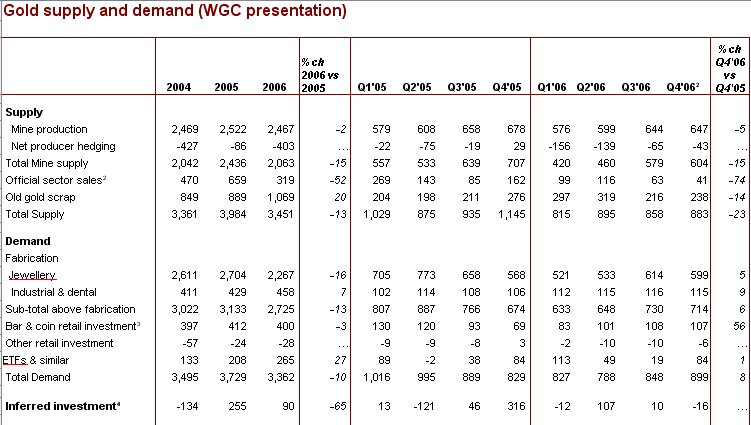
First we ask what drives the price of gold. Let us look at the facts and statistics of gold demand. Below is a table from the World Gold Council on gold supply and demand up to the end of 2006.


The supply figures are easier to collate than the demand side for the simple reason that the number of mining companies, governments and scrap recyclers is small and they tend to publish their numbers. On the demand side, the much greater number of jewellers, coin dealers, dentists, investment firms and a myriad of industrial users is harder to collect and analyse, even if they published their numbers. Hence we have an “inferred investment” at the bottom of 90 unaccounted tones for 2006. For the purposes of this study, we assume the balancing figure is proportionally distributed across all demand sectors.


Based on these statistics, how would gold perform during a prolonged economic contraction caused by any number of looming threats you may care to mention? One fact that leaps out with clarity is jewellery demand - gold is primarily an object desired for its beauty and value and rightly so. At 2,267 tonnes out of a total of 3,362 tonnes, jewellery made up 67% of total gold demand last year. Of this, India will be the perennial leader of jewellery demand with the USA a close second. We note that jewelry demand is down from a high of 75% in 2004 perhaps because of the higher price of gold. However, based on this fact alone, we can discount the effects of other demand factors such as industrial and dental as secondary to this study.


So, the pessimist may suggest that a credit, fiat or energy crisis would cause jewellery demand to plummet and hence smash the price of gold to smithereens. That seems logical, but another set of numbers suggests otherwise.


The period that interests us most is 1972-1980 when crude oil prices rocketed from $3 to $35, this was a crisis if ever there was one for historic gold prices to feed on. Oil prices delivered a hammer blow to the economy as they tripled in a matter of four weeks in February 1974. We talk about crude oil price tripling in four years between 2002 and 2006 – but four weeks? Think about that.


What was driving the gold price then despite flat or falling jewellery demand? The answer in terms of cause was oil and in terms of effect it was investment demand.


Indeed, to demonstrate the correlation between crisis (oil in this case) and gold, a study by Salomon Brothers back then showed that gold and Saudi Arabian Light crude both notched compound annual returns of exactly 31.6% between 1970 and 1980. The inflationary link between the two is strong. In fact, investment demand for gold consumed over 3,700 tonnes of gold in that decade which represented 25% of all demand. In the manic two years of 1979-1980, investment demand rocketed to 45% whilst jewellery demand slumped by half.


As a comparison to those heady days, gold investment demand hit a low of 5% in 2000 as relieved Y2K watchers dishoarded their bullion coins en masse. Today, investment demand has recovered to a 19% peak last year, but this is still less than half of what it reached in the inflationary 1970s! A look at the table below shows how investment demand in tonnes drove the price skywards while demand for jewellery either stayed flat or fell (data taken from Timothy Green, The New World of Gold).


1969

1970

1971

1972

1973

1974

1975

1976

1977

1978

1979

1980

1981

Jewellery

925

1085

1084

1020

540

248

539

961

1030

1031

756

542

809

Electronics

149

139

137

157

180

146

121

130

133

146

158

155

154

Official Coins

26

46

54

63

54

287

251

182

142

287

290

245

227

Dentistry

60

59

63

66

68

57

63

78

86

93

90

64

65

Other Industrial

63

62

69

70

72

67

59

65

67

75

79

62

62

Medals

44

54

52

41

21

7

21

51

52

50

34

41

29

Bar Hoarding

-53

-341

-2

-98

542

512

42

185

68

118

191

23

274

Total Investment

-26

-295

52

-35

596

799

293

367

210

405

481

268

501

Total Demand

1214

1104

1457

1319

1477

1324

1096

1652

1578

1800

1598

1132

1620

Gold Price

41

36

41

58

97

159

161

125

148

193

305