-- Posted Monday, 23 March 2009 | | Source: GoldSeek.com
On Wednesday, March 18, 2009, the Federal Reserve announced that it would “inject” (meaning print) over $1 trillion into the “economy” (meaning the banks who made irresponsible loans) over the coming year. Since last Sept., the Fed has already created just about $1 trillion, thus doubling its balance sheet. Now it is threatening to add another $trillion, which would triple its balance sheet. The money that the Fed creates in this way flows into the monetary base and then, with the aid of the private banks, flows into the money supply. So, allowing a few years for the banks to do their thing the Fed’s decision of March 18 will lead to a tripling of the U.S. money supply.
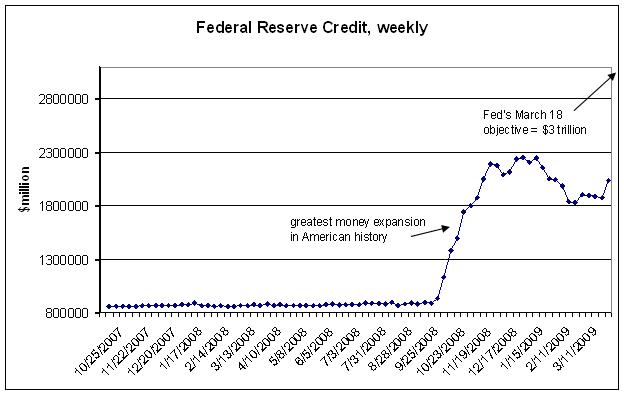
Once the money supply has tripled, the average price level in the U.S. will triple as well. This is a basic application of the law of supply and demand which was proven by Adam Smith at the very beginning of the science of economics. The supply of goods is what it is. It represents the result of everybody in the country working as hard as he is reasonably able, and it is not realistic to think that it is going to change in any major way. The demand for goods is money, and if money triples, then the demand for goods triples, and goods have to rise in price until demand and supply are back in balance.
There have been many such cases of significant increase in the money supply in American history. During the Civil War, WWI and WWII, the U.S. money supply doubled. In each case, the price level doubled as well. The War of 1812 is a very good case because the money to finance the war was created completely by private banks (there being no central bank from 1811-1816). Since New England was opposed to the war, its banks did not create money to finance it. The result was that prices rose at different rates in different parts of the country according to how much money the banks in that area had created. In New England, prices did not rise at all. Further it was clear to the people of that day that goods were not going up but rather that the money was going down. They spoke of the depreciation of the currency. Daniel Webster wrote that in Washington, D.C. a dollar had depreciated to 75¢ while in New England it had not depreciated at all.
When the Fed’s announcement came on March 18, the reaction of the markets was dynamic. Gold rose by $70. T-bonds rose by 5 points. The CRB index rose by 15 points, and the U.S. dollar depreciated by almost 4 points (against 6 foreign currencies). It was an explosion.
Why did the markets explode after this news item? Because the vast majority of the traders had no clue and did not expect such action. You follow the opinion pieces in economics, and you have a sense of what people are saying. Large numbers of advisers are predicting “deflation.” They are predicting a major decline in prices. Some of them are talking of another Great Depression (which would make more sense if the first Great Depression had actually been a depression).
If you ask these advisers why they think that such “deflations” sweep over the economy, they will reply that they appear mysteriously out of nowhere with no cause. In other words, these people do not understand the fundamentals of economics and have never studied American economic history. ALL PREVIOUS IMPORTANT PRICE DECLINES IN AMERICAN HISTORY HAVE FOLLOWED IMPORTANT DECLINES IN THE MONEY SUPPLY. THERE IS NO PRICE DECLINE WHICH APPEARED MYSTERIOUSLY OUT OF THIN AIR. Economics is a science, and science proceeds by cause and effect. Those who do not understand cause and effect are not scientists. Those who do not understand supply and demand are not economists.
In 1948, the Manhattan Bank (now merged with J.P. Morgan) set up a chair of economics for John Kenneth Galbraith at Harvard. Harvard agreed to appoint Galbraith to the chair to get the money. Manhattan Bank the got the prestige of Harvard to support a crackpot who defended the bankers’ privilege to create money. This was part of a larger program which ultimately corrupted the teaching of economics in the United States. Today the vast majority of those who have titles in economics are completely ignorant of true economics. Their “job” n our society is to defend the bankers’ privilege to create money. By shouting “deflation,” they provide a rationale for the Fed to ease. And this past Wednesday’s response by the Fed was a sign that they had done their “job.”
The media in today’s world are very stupid, and they are very impressed by titles. So they mindlessly repeat almost everything the “official” economists say. Time after time, they suck the public in to do the exact wrong thing. This scam is working at the present time exactly as it has worked in the past. The majority of the public and the media believe the people with the titles. These people are agents of the bankers. They repeatedly predict “deflation,” and their predictions are crucial to getting the Fed to print money. As a result, what happens is not “deflation;” it is “inflation.” They are always wrong, but this never registers with the media, who listen to their propaganda again and again.
A few weeks ago I discussed speculation and investment. The good speculator buys low and sells high (not necessarily in that order). He has a basic understanding of economic value, and he knows when goods are over valued and when they are under valued. Here is a situation tailor-made for the rational speculator.
The rational speculator must always consider two aspects of the situation. 1) Are goods undervalued or overvalued? What is the fundamental situation? 2) And then given the fundamentals, what are the other speculators thinking? Have they correctly anticipated the bullish (or bearish) situation and discounted it in the price? If this is so, we have been preempted, and there is no opportunity for profit.
But what we have now is the perfect case for the rational speculator. The Fed is tripling the money supply. That means that prices are going up, not by 10% or 20% but by 200%. (When the CPI broke the 10% per year barrier 30 years ago, it created a hysteria in the country. The media screamed “double digit inflation.” The price of gold was rising $50 per day. What do you think will happen when the media are screaming “triple digit inflation?”) This allows plenty of room for profit. Now has this 200% price advance been discounted by other speculators? Just the opposite has happened. The vast majority of the speculators in the markets are shorting to beat the band. They believe the “deflationists” and they expect lower prices.
To use an analogy, goods are like a stone in a child’s sling-shot. The child is riding in a convertible which is traveling up a hill at 200 mph. Then the child pulls back on the sling. What is going to happen to that stone? It is going to shoot ahead even faster than 200 mph. In this analogy, the speed of the convertible represents the long term rise in prices dating back to 2001; the pull-back of the sling represents the short term decline in prices from March to December 2008. Do you see what is going to happen?
Back last November I expressed the view that commodities were being driven down by fear on the part of speculators, fear induced by the media (as above). I predicted that these commodities would rebound and that the rebound would be led by gold. The reason for this is that gold speculators are more rational, less influenced by establishment economists and less influenced by the media. Since that time, gold has completely recovered its March to October 2008 decline and at this writing is back knocking on the door of $1000.
We can also note that crude oil is just completing the breakout of a triple bottom formation. Crude has certainly been on a speculative roller coaster over the past year. The New York Times helped to boost crude oil to its high last summer by coming out in May and making a big prediction for $200 crude. Those people who bought on the Times’ recommendation paid top dollar. Then in September the Times reversed itself and predicted a financial crisis, which was soon interpreted as involving a major decline in the price of virtually all goods.
This leads us to ask if those people who followed the New York Times’ advice are going to apply for loans from Carlos Slim?
The One-handed Economist is not afraid to spit in the face of the economic establishment. When I went to Harvard in the late 1950s, I said, “Gee, the economics department here is full of idiots.” It is still full of idiots. Its predictions are still wrong. And I am beating the pants off all the”good” little boys who believed every word their professors told them.
You can visit my web site, thegoldbug.net, and read some exciting social commentary (no charge) or subscribe to the One-handed Economist ($300/year) and get the hard nosed analysis of what to buy and what to sell that will put some do-re-me in your pocket.
Thank you for your interest, and keep your chin up because there are good times ahead for gold bugs.
-- Posted Monday, 23 March 2009 | Digg This Article | Source: GoldSeek.com


