-- Posted Thursday, 28 June 2012 | | Disqus
The world economy today stands at the doorstep of great change. A gathering crisis looms in Europe, splitting the Continent into two competing blocs. While leaders there face off against one another in a high stakes game of chicken, the rest of the world powerlessly watches the train wreck slowly unfold. Political leaders on both sides of the Atlantic fail to grasp the fragility of the current world order and do not understand the forces they are unleashing. A parallel here can be drawn with the political situation that existed on the eve of the First World War. For the most part European leaders were not bent upon death and destruction. However these largely ordinary men were held captive by national delusions and a complex system of alliances and treaties that had not been thought through to their logical conclusions. This resulted in a situation where a single assassination was enough to plunge the Continent into a bloodbath.
Although we are not on the brink of a world war, leaders today are nonetheless currently faced with economic and financial conditions of a similar dimension. Confronted with economic problems that they are unable to understand and political problems that they are unwilling to untangle, they're hoping to solve existing problems by injecting ever greater quantities of printed money into their economies. And just as the leaders prior to World War I could not have predicted the massive loss of life that their actions were to bring, so too do world leaders today appear blind to the consequences of unrestrained money creation and the urgent need for free market reform.
Last week's G-20 meetings were a case in point. Though the conference featured much high sounding talk, there was little effective action. Meanwhile, the world economy moved inexorably towards recession as the Anglo-Americans urged more Quantitative Easing (QE). As indicated in this column, the U.S. dollar has experienced a temporary rise and, as recessionary forces emerged, gold hovered, even sliding in terms of the U.S. dollar.
But, much to the frustration of politicians, all the previous policy errors and prior money creation are simply not producing the desired results. Instead, unemployment remains high and real estate prices continue to stagnate in most parts of the world, devastating the morale of consumers. Businesses, faced with falling consumer demand, continued high taxes and regulatory uncertainty, are hiring at a rate so slow that the number of long-term jobless continues to grow.
Keynesian world leaders look on in barely disguised panic as their policies of cheap, easy money fail to affect meaningful change. QE has lost public credibility and, indeed, has become politically dangerous. Despite this, Keynesian central banks such as the Bank of England, though having halted their $511 billion QE program in May, recently considered flooding the British banking system with even more paper money to encourage business and consumer lending. In his annual policy speech to London financiers on June 14, Bank of England Governor Mervyn King said that, "With signs of deterioration in the outlook, especially in world markets, the case for a further monetary easing is growing."
Meanwhile other central banks, such as the Fed and the European Central Bank, have resorted to disguised QE in the form of 'twist operations,' and have lowered the quality of securities they will accept as collateral. But despite all the tricks, both old and new, recession keeps creeping in. They still think the answer is more money. And in much the same way that the generals of World War I continued to order frontal offensives, even after each prior assault had proven useless, today's politicians continue to pump fiat money into the front lines.
So in such an environment, what are investors to do?
Many buy precious metals. They do this to hedge against inflation and to protect themselves from currency deterioration. As the need for immediate liquidity increases in a recession, though, gold and silver are often sold to provide it. As recession looms, it's likely that those hedging against inflation are selling off.
As a result, the short-term outlook for gold and silver remains volatile, reflecting chronic political uncertainty. In the longer term, however, precious metals may be set up to rise in price as the promised recovery fails and recession leads to depression. The ensuing political panic and fears of a collapse of the fiat currency system should exacerbate the demand for those assets that are seen as a safe haven.
In a recession, cash is king. But as a currency deteriorates, gold is king. By their panicked misunderstanding of economics world leaders are threatening to create a world of crippled and shell shocked currencies. Investors should look progressively more towards precious metals as a possible safe haven.
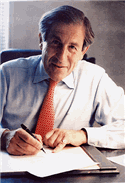
John Browne is a Senior Economic Consultant to Euro Pacific Capital. Opinions expressed are those of the writer, and may or may not reflect those held by Euro Pacific Capital, or its CEO, Peter Schiff.
Subscribe to Euro Pacific's Weekly Digest: Receive all commentaries by Peter Schiff, John Browne, and other Euro Pacific commentators delivered to your inbox every Monday!
Order a copy of Peter Schiff's new book, The Real Crash: America's Coming Bankruptcy - How to Save Yourself and Your Country, and save yourself 35% off!
-- Posted Thursday, 28 June 2012 | Digg This Article | Source: GoldSeek.com