-- Posted Wednesday, 20 March 2013 | | Disqus
[The following guest editorial was written by a regular contributor to the Rick’s Picks forum who goes by the handle 'Ragnar'. His past essays here have generated a tidal response. RA]
Most start-up companies are founded on an idea, unbounded enthusiasm, hard work, and luck. Without luck or exceptionally deep financial wells, most of them fail. There is a bon vivant spirit within the workplace, like everyone is contributing to the establishment of something great; and everyone participates in the flair and the excitement in the air. Huge sale-commissions are part of the mix; expert managerial techniques usually are not. The name of the game is market share, market share, market share for companies based in new fields or on new ideas, particularly in high tech fields.
I knew that the housing market was going to fall hard after 2003, and that it should have hit a wall that early, and I told everyone who would listen. But I am not a billionaire like John Paulson. He found a way to reap billions from this calamity. I did invest in gold at $300 per ounce but did not find a way to reap billions. The principal players in the private equity and hedge fund companies (often the same people) have become billionaires in this field of activity, which started burgeoning in the ‘90s. Of course, anyone at this time in financial history who had the contacts and the chutzpah to borrow, leverage to the hilt, or convince investors (primarily pension, university, and other foundation funds with large amounts of capital) that they were the best choices to handle their funds had odds that highly favored success. Were many of them brilliant? Undoubtedly. Was luck a more important ingredient to their success?
To answer that question, let’s ask some more questions. Does it look like the markets will increase by 1,000% in the next two decades? How many hedge funds have gone public? Who thinks that was done for altruistic motives? Who thinks that the hedge fund leaders thought that their earning powers had peaked and that they had better get out at the top? How have Paulson’s investments performed since his put options on housing? How are the other public hedge funds performing?
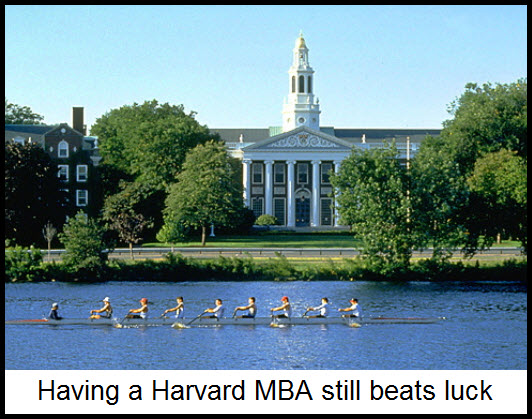
Let me give you an example of one investment in the tech field by one of these companies. The company had expanded to capture 50% share of the market. It looked like a field of endeavor that could expand in a market downturn. It paid extravagant salaries and bonuses to the people who helped it achieve this market share. These employees often had no more than a high school education, but they knew how to sell in a new field that was wide open. There were big parties. There was King Kong camaraderie. Everyone was on the team. There were no Harvard MBAs, just the wild, wild, West and an all-out race for market share. Upon reaching 50% market share, it became apparent that the company’s wild expansion could not continue using the same management and sales techniques. Enter the hedge fund buyout.
Go Public, Cut Salaries
What to do? Answer: Prepare to go public by turning the company into a well-managed company using principles that they learned at Harvard; then, use those principles to tame the wild beast into a properly managed company which could maximize profits. How? Take each department of the company and start cutting salaries and bonuses. Hire new employees who had university degrees but would work for less. Cut out the big parties. Start firing the highest earners and replace them with newbies who would work for a fraction of what they had been paying. Start replacing key managers with their own people. That’s par for the course.
So what’s the problem? The hedge fund decided that the bull market wasn’t going to last long enough to reorganize in the original time frame, and that the IPO had to occur before the end of the year. Things got rushed. Nobody knows who will be fired next. The camaraderie is gone. No one feels the company is loyal to them, so why reciprocate? Everyone with experience is looking for a new job. The department managing the largest group of clients was told that their earnings would be capped at a fraction of what they were currently earning, and that their multi-year relationships with clients would be terminated. All service would be done by the next person to take the call, in essence making all accounts house accounts. Prices on all services and products are being raised, sometimes doubled. Profits must be maximized so that year over year profits are increasing massively in order to justify heady p/e ratios in an IPO.
Spiraling Toward Failure
Textbook. Wrong. Common sense would tell you to gradually reduce commissions and bonuses would be putting the frog in the pot. The sales people would not like it, but would have gradually learned to live with it. The big boys had accounts that produced big bonuses without doing much new work. They were coasting. What to do? Reduce the account force by 10 percent and consolidate with the remaining account executives. Retain the relationships with the clients. Later, reduce it by another 15 percent. Later, have a meeting and explain that they executives were not working hard enough and that the fat had to be cut. The account executive force would be cut in half with the work consolidated among the remaining people. Those who produced the least amount of profits would have to go, but those remaining would still make big bucks. Then bring in some new people in a junior status who would work for a fraction of the price to gradually take over more and more of the accounts.
What actually happened? The smaller account executives are bleeding out. Their incentive to work hard has been decimated. Most are looking for new jobs. The large account executives left en masse. The managers offered severance pay which was not equal to unemployment. They offered what amounted to 3% to 5% of their salaries in exchange for signing a non-compete clause. The new Harvard boys hadn’t even figured out that the entrepreneurs hadn’t had their employees sign non-compete clauses upon their hiring. Want to guess what those account execs are going to do with those multi-year relationships? Guess how many millions of dollars in annual sales are going to be taken elsewhere. Guess how many large accounts are going to sit there and take a doubling of their costs. Guess what is going to happen to those projected increased profits produced by ivory tower theories devoid of common sense.
Not Worth High Fees
Is this what people are paying two percent on assets and 20 percent of profits for? How long will that continue? I don’t know, but I am willing to bet against it continuing for much longer. The only problem is, the ability to continue doing business as a small business is being regulated to death. At some point, the only way to get business will be through government connections. Big business will continue to support increased regulation and lobby for special breaks in the tax code because they know it will cause the disintegration of many of their smaller competitors who don’t have the money for compliance and lobbying (or a Harvard MBA). But that is a subject for another day. So what is the moral of this story? Is common sense dead? Does it matter, or will luck prevail? I am willing to bet that luck has run its course and that the day of the hedge fund is dying. Alas, I don’t have billions to bet with. Nor do I have a Harvard MBA. But I would settle for luck.
-- Posted Wednesday, 20 March 2013 | Digg This Article | Source: GoldSeek.com