-- Posted Monday, 22 June 2009 | Digg This Article | | Source: GoldSeek.com
By Frank Holmes
CEO and Chief Investment Officer
Gold stocks are among the most volatile asset classes, but old and new research shows that their judicious use can enhance investor returns without adding portfolio risk.
U.S. Global Investors has updated research on gold stock investing by Jeffrey Jaffe, a finance professor at the Wharton School, that was published in the Financial Analysts Journal in 1989. Prof. Jaffe’s study covered the period from September 1971, just after President Nixon ended convertibility between gold and the dollar, to June 1987.
The Jaffe study concluded that adding gold and gold stocks to a large portfolio increases both risk and return, but that the additional return from these non-correlative assets more than compensates for the additional risk.
During the study period, gold bullion saw an average monthly return of 1.56 percent, considerably better that the 1.06 percent average monthly return for common stocks represented by the S&P 500. Gold stocks shone even brighter, returning an average of 2.16 percent per month.
On the risk side, gold and gold stocks had greater volatility (measured by standard deviation) than the S&P 500. But Jaffe found that, due to their non-correlative qualities, adding gold-related assets to a diversified portfolio would likely reduce overall risk.
We picked up the Jaffe study’s result for gold stocks (measured by the Toronto Stock Exchange Gold and Precious Minerals Total Return Index, converted to U.S. dollars) and compared it to the S&P 500 Total Return Index from September 1971 through the end of May 2009.
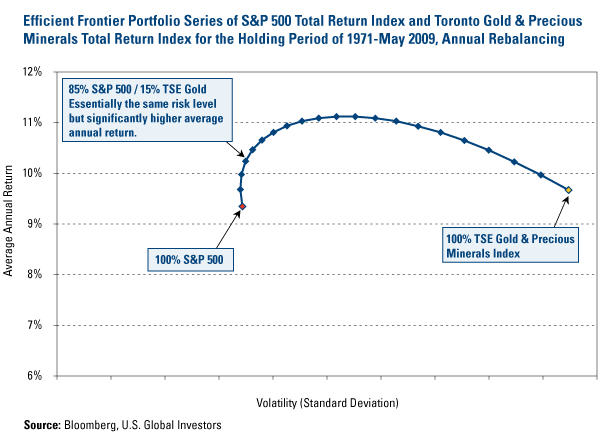
Our research included creation of an efficient frontier series to establish an optimal portfolio allocation between gold stocks and the S&P 500, with annual rebalancing. As you can see on the chart above, a portfolio holding 85 percent S&P 500 and 15 percent gold equities has essentially the same volatility as the S&P 500 (horizontal axis) but delivered a higher return (vertical axis).
Between September 1971 and May 2009, the S&P 500 averaged a 9.34 percent annual return. A 15 percent allocation to gold equities, with annual rebalancing, would have yielded on average an additional 0.89 percent per year.
How much is 0.89 percent per year? Assuming the same average annual returns since 1971 and annual rebalancing over 25 years, a $10,000 investment in the portfolio with 15 percent gold stocks would be worth about $114,000, 22 percent more than the 100 percent S&P 500 portfolio, while adding virtually zero risk.
U.S. Global Investors consistently suggests up to 10 percent gold in a portfolio allocation, so we also looked at returns for investors at that level. A 10 percent allocation to gold equities, with annual rebalancing, would have yielded on average 0.63 percent more than an exclusive S&P 500 portfolio.
In dollar terms, the $10,000 investment in the 90-10 portfolio would grow to $107,611 over the ensuing 25 years (assuming annual rebalancing), compared to $93,210 for the portfolio solely invested in the S&P 500.
And when you look at the efficient frontier in the chart, the 10 percent weighting is two diamonds above the 100 percent S&P 500 allocation. You can see that adding gold stocks also increases return with no increase in the portfolio’s volatility.
More than two decades and many ups and downs have passed since Prof. Jaffe published his study, but our follow-on research shows that the relationship between gold, investor returns and volatility has remained pretty much the same.
####
Frank Holmes is CEO and chief investment officer at U.S. Global Investors, a Texas-based investment adviser that specializes in natural resources, emerging markets and global infrastructure. The company’s 13 mutual funds include the Global Resources Fund (PSPFX), Gold and Precious Metals Fund (USERX) and the World Precious Minerals Fund (UNWPX).
Frank will be hosting a special webcast double feature this week. On Thursday, June 25, Frank will discuss key signs that the worst is behind us. Register for “Searching for Signs of a Recovery” here. Then on Friday, special guest Andy Rothman, CLSA’s chief macro strategist, will present on China’s Impact. Register for “China’s Impact” here.
Please consider carefully the fund’s investment objectives, risks, charges and expenses. For this and other important information, obtain a fund prospectus by visiting www.usfunds.com or by calling 1-800-US-FUNDS ( 1-800-873-8637 ). Read it carefully before investing. Distributed by U.S. Global Brokerage, Inc.
All opinions expressed and data provided are subject to change without notice. Some of these opinions may not be appropriate to every investor. Foreign and emerging market investing involves special risks such as currency fluctuation and less public disclosure, as well as economic and political risk. Gold funds may be susceptible to adverse economic, political or regulatory developments due to concentrating in a single theme. The price of gold is subject to substantial price fluctuations over short periods of time and may be affected by unpredicted international monetary and political policies. We suggest investing no more than 5% to 10% of your portfolio in gold or gold stocks. Because the Global Resources Fund concentrates its investments in a specific industry, the fund may be subject to greater risks and fluctuations than a portfolio representing a broader range of industries. The S&P/TSX Global Gold Index is an international benchmark tracking the world's leading gold companies with the intent to provide an investable representative index of publicly-traded international gold companies.The Toronto Stock Exchange Gold and Precious Minerals Total Return Index is the total return version of the Toronto Stock Exchange Gold and Precious Minerals Index with dividends reinvested. The S&P 500 Stock Index is a widely recognized capitalization-weighted index of 500 common stock prices in U.S. companies.
-- Posted Monday, 22 June 2009 | Digg This Article | Source: GoldSeek.com


 Gold Stocks Can Add Returns With No Extra Volatility