The correction in gold prices should be over, perhaps following Friday's employment report. Next stop = $475. The catalyst will be a continued deterioration in the outlook for the US dollar, and a rotation in interest out of some of the other commodities that gold has been underperforming as markets abandon the recovery trade. Inflation fears do play into the picture but that's more an inevitable result of the current process - which is to embolden them if you will. The price rises have to pinch the labor market enough that labor starts to recognize they have something to do with a currency debasement. People are buying gold today because they expect inflation fears to surface tomorrow, which will cause others to buy and drive it higher the day after. Remember, variations in the value of money can be obscured by the data because the data doesn't try to measure them in the context of the above process. The data merely hides what's really going on - that we are living off our capital base. But during periods of obvious currency devaluation it becomes more difficult to hide changes in prices, and it is then only a matter of time before they become prevalent enough for all agents to see and participate in. There is no better reason to buy gold today than to speculate on this future course of events. If it weren't for that additional variable, any commodity would do as a hedge against the decline in currency values. But when inflation fears mount, the bulk of the gains go to gold. 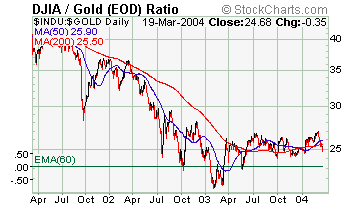 Last week I showed a chart of the S&P 500 in terms of USD gold rather than US dollars under the nutty assumption that gold might represent a sounder money, you know, to help you figure out if you're spending profits or capital - stuff nobody cares much for these days. Anyway, suffice to say it looked even worse than these two. Last week I showed a chart of the S&P 500 in terms of USD gold rather than US dollars under the nutty assumption that gold might represent a sounder money, you know, to help you figure out if you're spending profits or capital - stuff nobody cares much for these days. Anyway, suffice to say it looked even worse than these two.
I was trying to make the point that real gains have most likely been overestimated, since most valuation measures (PE's are most common - it doesn't matter much if they're the best measure of value because we're dealing within a historical context) don't yet take into account the inflation environment that gold bulls have been forecasting for three years now, and hope to make more apparent by breaking past the 1996 high at $428. 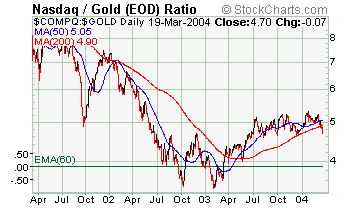 In other words, values for financial assets are still off the charts, implying a benign inflationary environment. In other words, values for financial assets are still off the charts, implying a benign inflationary environment.
Commodities continue to take turns racing each other to new multi-year highs meanwhile. Copper bulls are staring at the potential of a near term shortage in copper inventories. Copper prices have nearly doubled over the past 12 months to about $1.40/lbs - to new eight year highs. And now they're only 10 cents from making fresh 15 year highs. After that it's back to the levels of the seventies, and this mostly all in six months. Tell me that won't show up in the CPI or PPI or wages - when they finally have to be bargained higher so that workers can afford to buy "things." Platinum prices as you know are off to new 24 year highs. Silver prices have traded up in a parabolic fashion closing at their best levels since the late eighties as if another big squeeze was underway. All of this and more helped push the CRB also up to new 20- year highs briefly - its best level since 1984 - after it broke out of a four year double bottom early last year (in dollar terms). While most gold ratios have bottomed somewhere between 1998 and 2001 in the long term trend (meaning gold has generally outperformed most commodities from those periods including platinum and oil and silver), over the past 6 to 12 months it has slid back into more or less obscurity while other commodities have popped to life one by one as though it were a giant popcorn machine. So why has gold sat out the party so far even though the US dollar has fallen quite consistently since 2002? 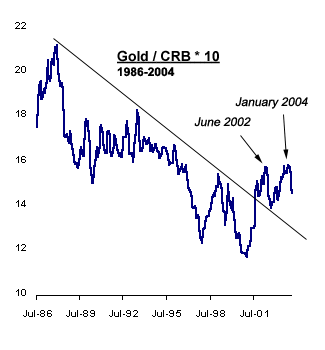 Remember first that gold was an early performer in 2001; as we said at the time it was predicting the US dollar's rollover and the subsequent run in commodities while most everyone else was either in the disinflation or deflation camp. Remember first that gold was an early performer in 2001; as we said at the time it was predicting the US dollar's rollover and the subsequent run in commodities while most everyone else was either in the disinflation or deflation camp.
In the meantime, many gold ratios peaked during the summer of 2002. Some peaked earlier like Oil and Platinum for example. Some peaked later like the gold/silver ratio, which peaked just this past summer. But mostly, after the March 2003 break out in gold signaled the new monetary environment, the gold ratios began turning down more obviously. Gold prices continued to charge higher until they made new 16-year highs in January 2004. But they chronically and increasingly underperformed all of the metals during the last half of 2003, as well as the precious metals since January, and so the Gold/CRB ratio backed off once again. Importantly, the Gold/Dow ratio peaked in February 2003 (the opposite of the bottom in the first chart above). What that implied to me is that confidence started to return to the economy (recovery theme) in general even though the evidence suggests the results were mostly monetarily induced;, even though the Fed failed to persuade bond traders in June 2003 likewise that inflation didn't exist; and even though the labor market surplus has dogged bullish predictions consistently. Everyone expected the down turn in the broad market that started last month. It came anyway. But now some are looking for a bottom because they figure the bear market is over and this is the buying opportunity they've waited for. Interestingly it's not easy to persuade people that this sell off is the beginning of a new bear market leg in the averages. For one, few people buy our arguments that the higher commodity prices are the result of a monetary policy that has overvalued the dollar and is resulting in the kind of devaluation it undergoes every 20 to 30 years, yet. Most people think the weak dollar is deliberated, despite the fact that every day you hear how the Bank of Japan has been mortgaging the house to support it. That policy is rumored to be approaching an end. But if the dollar doesn't find support on its own it'll continue, perhaps. And if it doesn't, the corrective forces are likely to work against the greenback. 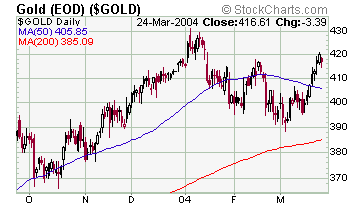 As the frequency of geopolitical shocks has picked up pace in recent weeks, the trends have largely turned to favor gold again. Since last Friday gold prices have charged more than $20 and are threatening to reverse their two and a half month downtrend. As the frequency of geopolitical shocks has picked up pace in recent weeks, the trends have largely turned to favor gold again. Since last Friday gold prices have charged more than $20 and are threatening to reverse their two and a half month downtrend.
There's resistance at about $418, but maybe support soon, and I see no reason why we shouldn't break out soon and head off to challenge the 1987 high as copper and silver, and various other commodities have in a cycle that is obviously a monetary illusion and that - if history is any guide - should be led by gold when it is recognized. The following is an excerpt from Monday's article to subscribers illustrating why I think that gold is cheap relative to other "things," and more importantly, why it ought to begin to outperform from here (if you've seen it skip to the next section for a conclusion): Monday March 22: Looking For PE Contraction to Continue
Forget about the geopolitics. If you want the real reason the stock market is going to be taking a hit, have a look at the meaning in the graphs here: 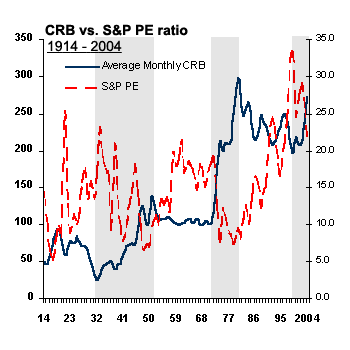 Note the inverse correlation between commodities and stock market earnings multiples (gray areas represent past periods of downward currency adjustments, as is the case today except today it's only beginning). It stands out as clear as day and it's what I've been trying to hammer home, that currency debasements (inflation at source) ultimately result in lower stock market earnings multiples as people finally wake up to the fact that money profits aren't the same thing as real profits. Of course war and violence tends to go hand in hand with such confusing circumstances, which in this case started at least three years ago. Note the inverse correlation between commodities and stock market earnings multiples (gray areas represent past periods of downward currency adjustments, as is the case today except today it's only beginning). It stands out as clear as day and it's what I've been trying to hammer home, that currency debasements (inflation at source) ultimately result in lower stock market earnings multiples as people finally wake up to the fact that money profits aren't the same thing as real profits. Of course war and violence tends to go hand in hand with such confusing circumstances, which in this case started at least three years ago.
For, just as the positive results produce delusions of grandeur, so do the negative consequences tend to reinforce paranoid delusions, and inflame disagreements… if only out of sheer desperation. 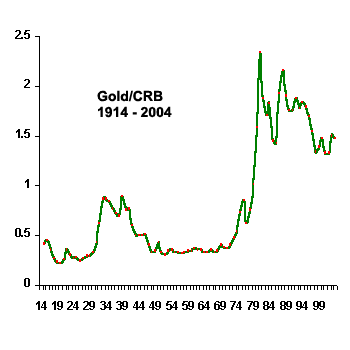 So in the spirit of keeping it simple, now that you know that periods of sharply rising commodity prices historically produced lower PE multiples and usually higher interest rates, have a look at the Gold/CRB chart to the right. So in the spirit of keeping it simple, now that you know that periods of sharply rising commodity prices historically produced lower PE multiples and usually higher interest rates, have a look at the Gold/CRB chart to the right.
We can derive two things from this: a) During periods of monetary debasement gold rises faster than most commodities
b) Excluding the past few months that tendency is already underway
Hence, the bull market in gold if that's what it is, is in all likelihood still really young. But here's the theoretical underpinning anyway since most people probably still don't believe it: monetary value shifts from paper to gold increasingly during times when the US dollar undergoes one of those periodic devaluations against most "things" because that happens to be when its devaluation is most obvious to the naked eye, and consequently when its monetary value inflates the most. In short, this is why gold has tended to outperform in gold bull markets past. Well, is it or isn't it this time 'round?! 'Tis!
What of the USd if Markets Abandon the Recovery Theme?
Since the US dollar has fallen while stock prices have risen, isn't it possible that if stock prices fall the dollar will bounce? Well, citing our above argument again, stock prices may have bounced in dollar terms, but they've underperformed world markets (the chart below is a good explanation for the dollar's bear market). The question is, if the Dow falls will investors that have been buying foreign assets suddenly reverse course and start buying up US shares again? 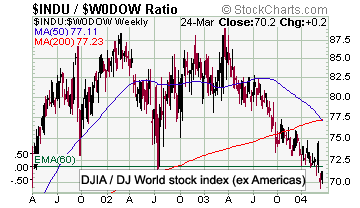 There is only one way that I could see the USd recovering meaningfully near term. If the Fed tightens convincingly even after the initial reaction for stocks and the dollar is for them to fall to new lows. Good luck. There is only one way that I could see the USd recovering meaningfully near term. If the Fed tightens convincingly even after the initial reaction for stocks and the dollar is for them to fall to new lows. Good luck.
For the correct analysis in my view is that the US dollar remains overvalued and that this is evidenced by the direction and size of the trade deficit as well as the increasing underperformance of US assets relative to overseas assets (stocks and bonds), and when you consider that throughout the US dollar's decline since 2002, foreign central banks have increased their purchases of dollars to no avail. It keeps falling. Aside from monetary policy part of the fuel for the dollar's bear market rout also stems from the administration's policies. But these aren't deliberated, as in a weak dollar policy. Rather, they result from what are perceived by outsiders and allies as isolationist policies by the administration in its unpopular war in Iraq, controversial trade practices, and its blatant disregard for fiscal prudence. The message they're sending is we're building a wall around America. This has consequences for US dollar policy because its underpinning relies on an increasing centralization of global banking policy based on an alliance that agrees to buy Al's easy money in exchange for the privilege to trade. Thus, in the world that trades, the US dollar is still considered money. But demand for it isn't keeping pace with the supply produced by the Fed's accommodative stance. Yet the result of monetary policy instead has been that investor confidence has been stoked, helping to slow the dollar's decline in the process by keeping the gap between the underperformance of US assets and foreign assets from widening as fast as it otherwise might. As we've argued, investors are being fooled by the nature and extent of those gains. Not just relative to the decline in the value of the US dollar, but also relative to the performance of non-US assets. They are also being fooled by the monetary impact on general economic data, a program that is unsustainable no less. The drop in the value of the US dollar that began almost three years ago did not correct the underlying imbalances. The dollar is even more overowned, and the trade & budget deficits are larger than ever. And the so-called economic recovery in real terms is too sobering to think about. This is directly the result of monetary policy and the trap it's in: raising interest rates at this point would probably have the effect of shutting down the traditional sources of demand for the dollar due to the impact of the tightening on optimistic asset values persuaded by an artificial boom in economic activity. So regardless of the occasional PR stunt from inside the Fed, it is not in their interests to be seen causing a stock, bond, and currency crisis revealing the phony nature of the current recovery they themselves produced. Conclusions
The catalyst should come from gold itself, for the same reasons it has traditionally rallied ahead of significant down turns in the greenback - in anticipation of bearish news flow for the US dollar. The underperformance of gold relative to the other commodities over the past year suggests that gold lost some marginal support to the recovery theme as investors have been persuaded to some extent by the nominal gains in stock prices. 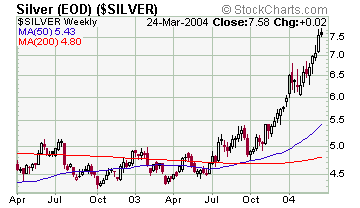 But interest in the precious metals generally has become increasingly apparent again this year (manifesting in silver and platinum), coincident with a down turn in stock prices generally thus perhaps indicating some new detractors from the recovery theme, which in turn has made gold's underperformance even more conspicuous. I would say it cheapened it. Any news not supportive of the recovery trade is still bearish for the US dollar and dollar denominated asset values, and should reflect in gold prices over and above the change in the value of an industrial commodity or currency to the extent it implies that the artificial boom is about to bust. But interest in the precious metals generally has become increasingly apparent again this year (manifesting in silver and platinum), coincident with a down turn in stock prices generally thus perhaps indicating some new detractors from the recovery theme, which in turn has made gold's underperformance even more conspicuous. I would say it cheapened it. Any news not supportive of the recovery trade is still bearish for the US dollar and dollar denominated asset values, and should reflect in gold prices over and above the change in the value of an industrial commodity or currency to the extent it implies that the artificial boom is about to bust.
This simply means it's gold's turn to shine as the market abandons the recovery theme; if only on grounds that the policy responsible for the artificial boom isn't producing the same marginal bang for its buck. Gold prices should anticipate this bearish news flow and its impact much as they did back in 2001 - when they rose against the dollar before it turned down and against most (but not all) other commodities before they turned up. At the very least gold should confirm the commodity highs made elsewhere by lunging at its 1987 high. I'd settle for even our modest target of US$475 for now even if there's good reason for it to go many times higher. The January high at $428 (8 points past the 1996 high) was a first attempt to confirm gold's bull market - since the 1996 high is the bear market parameter in most models. A second attempt seems to be underway now. If all gold was to do was to confirm the other commodities the attempt is going to be successful. Edmond J. Bugos The Goldenbar Report
P.O. Box 4642
V.M.P.O.
Vancouver, BC
Canada V6B 4A1 |