|
-- Posted Friday, 22 January 2010 | Digg This Article | | Source: GoldSeek.com | | Source: GoldSeek.com
Having been among the economic engines of Europe for much of the past decade, it appears as if the British economy has run out of steam. Inflation is rising while bankruptcies and unemployment continue to swell. It is a problem that would have left Lord Keynes' head spinning. In many ways, the responses of the U.S. and U.K. governments to the financial crisis have been very similar. So far, the American advantages in size and reserve currency status have allowed us to avoid the storm-clouds now descending upon Britain. But these advantages only provide a temporary respite. In the meantime, the slow-motion collapse in Britain offers a glimpse of our own future - and a chance to prevent it.
The history of the United States and the United Kingdom are closely linked in almost every essential manner, from culture to defense to economics. This is hardly surprising because the Founding Fathers were basically British subjects who wished to restore the traditional liberties they were guaranteed in the mother country.
After the Revolution, America went its own way with enhanced freedoms that led to unprecedented prosperity. Most interestingly, the American Constitution was quiet on the subject of central banking. Two early efforts to imitate the British central bank were withdrawn. But in 1913, Congress eventually agreed to establish the Federal Reserve, which persists today as America's central bank.
Many economists trace America's economic decline to the activities of the Fed, in particular to the printing of massive amounts of fiat currency unsupported by the gold and foreign exchange reserves held by the central bank. It is a systemic fraud previously committed in Great Britain. But why would a country's leadership pursue such a dangerous course?
Foreign policy is a prime suspect. The center of a vast empire that covered almost a quarter of the world's land mass and one third of its people, Great Britain accepted the role of 'global policeman' for much of the late 19th and early 20th centuries. As with ancient Rome, this proved vastly expensive both in terms of money and domestic tranquility. Funds diverted from the home nation hurt working people disproportionately, fueling socialist activism. Eventually, the empire rotted from within.
America took over the role of world policeman from the British after the Second World War. Predictably, it has proved hugely expensive, both in terms of money and domestic tranquility. Today, the debts are mounting almost at an exponential rate, such that the U.S. government's current liabilities stand at a staggering $12.3 trillion or some $113,000 per taxpayer. [2009/01/20; usdebtclock.org] And if the recent election of a Republican Senator in Massachusetts is any indication, the people are fed up.
When I was a Member of the U.K. Parliament, under the now legendary Prime Minister Margaret Thatcher, we were successful in dismantling decades-worth of socialism and 'progressive' conservatism. The new freedoms unleashed an explosion of enterprise, investment and wealth creation. Thatcher cut back relentlessly on government waste and reckless spending. Initially, it resulted in an increase in unemployment - unpopular, but it worked. Thanks partly to oil exports, we instituted a public debt repayment schedule. Sterling rose from some $1.12 to $1.80. [1985-1988; miketodd.net/encyc/dollhist-graph2.htm]
Three successive socialist governments in the United Kingdom now have undone most of the good done by Thatcher. Westminster put pressure on the banks to make unaffordable property loans, just as Washington did to America. The British government has run up unprecedented levels of debt to finance the banks and its national debt, by means of quantitative easing, just as the American government has done.
Unlike America, Britain's pound sterling has long since lost the protective shield of being the world's official reserve currency. Therefore, the British are confronted with inflation and a possible credit downgrade now, while America still has time to reverse course.
If it does not, America may soon follow Britain into a lower credit rating, with untold damage to Treasury financing costs and the U.S. dollar.
However, shifting to a sensible economic path will inevitably involve short-term pain, as it did under Prime Minister Thatcher. Correcting the irresponsibility of socialism can be agonizing. Over the short-term, it may have a negative effect on U.S. stocks, even while the shares of the BRIC-CAN countries continue to rise.
Lady Thatcher once said, "The trouble with socialism is that eventually you run out of other peoples' money." Once again, the U.K. is broke, and this time, the U.S. is hardly far behind. For a more in-depth analysis of our financial problems and the inherent dangers they pose for the U.S. economy and U.S. dollar, read Peter Schiff's 2008 bestseller "The Little Book of Bull Moves in Bear Markets" and his newest release "Crash Proof 2.0: How to Profit from the Economic Collapse." Click here to learn more.
More importantly, don't let the great deals pass you by. Get an inside view of Peter's playbook with his new Special Report, "Peter Schiff's Five Favorite Investment Choices for the Next Five Years." Click here to download the report for free. You can find more free services for global investors, and learn about the Euro Pacific advantage, at www.europac.net.
-- Posted Friday, 22 January 2010 | Digg This Article | Source: GoldSeek.com
- John Browne Senior Market Strategist, Euro Pacific Capital, Inc.
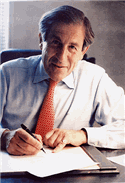
John Browne is the Senior Market Strategist for Euro Pacific Capital, Inc. Working from the firm’s Boca Raton Office, Mr. Brown is a distinguished former member of Britain's Parliament who served on the Treasury Select Committee, as Chairman of the Conservative Small Business Committee, and as a close associate of then-Prime Minister Margaret Thatcher. Among his many notable assignments, John served as a principal advisor to Mrs. Thatcher's government on issues related to the Soviet Union, and was the first to convince Thatcher of the growing stature of then Agriculture Minister Mikhail Gorbachev. As a partial result of Brown's advocacy, Thatcher famously pronounced that Gorbachev was a man the West "could do business with." A graduate of the Royal Military Academy Sandhurst, Britain's version of West Point and retired British army major, John served as a pilot, parachutist, and communications specialist in the elite Grenadiers of the Royal Guard.
In addition to careers in British politics and the military, John has a significant background, spanning some 37 years, in finance and business. After graduating from the Harvard Business School, John joined the New York firm of Morgan Stanley & Co as an investment banker. He has also worked with such firms as Barclays Bank and Citigroup. During his career he has served on the boards of numerous banks and international corporations, with a special interest in venture capital. He is a frequent guest on CNBC's Kudlow & Co. and the former editor of NewsMax Media's Financial Intelligence Report and Moneynews.com.
Previous Articles by John Browne, Senior Market Strategist, Euro Pacific Capital
|