|
-- Posted Thursday, 4 February 2010 | Digg This Article | | Source: GoldSeek.com | | Source: GoldSeek.com
President Obama's State of the Union message only serves to reinforce my forecast that investors will continue to find better returns in markets outside America and in currencies other than the U.S. dollar. Indeed, the reward gap may well increase.
Nothing in the President's speech indicated willingness to do the hard work of cutting spending. Rather, he reiterated his commitment to a costly new healthcare entitlement and more spending on make-work programs. Only days later, his budget acknowledged that, even before factoring in the cost of his proposals, the federal government is unlikely to be in surplus for the foreseeable future. In response, Moody's has issued a warning that the United States' triple-A credit rating is not unassailable. In short, the trend set some ten years ago will continue.
Since 1999, those who invested in U.S. stocks, as measured by the S&P Index, have lost about half of their wealth, in real terms.[i] On the other hand, those who invested abroad, measured by the Morgan Stanley Emerging Market Index,[ii] [iii] have doubled their investments in real terms. This is because capitalism is flourishing abroad, while being curtailed progressively in so-called advanced economies, where the projected aggregate growth rate for 2010 is now only some 2.5 percent. Somewhat optimistically, this assumes no double dip recession. [iv]
Most of the emerging economies are far less leveraged than those of the advanced countries and are relatively well insulated from the massive dollar deleveraging that began in 2007. Crucially, their government spending is geared largely to infrastructure and far less to expensive government bureaucracy and wealth-depleting entitlements. Most importantly, even formerly communist governments, like that of China, have embraced free-market capitalism, while many in the advanced governments are flirting with socialism.
As the most leveraged of the major economies, America in particular faces great problems with regard to regenerating consumer demand. Looking at the future of U.S. stock markets, the following five bearish observations stand out.
First, it appears that the ruling Democratic Party is out of touch with the realities of economics. Paying little apparent heed to their sensational defeat in Massachusetts, President Obama and his Democrat Congress are making no realistic attempt to rein in, let alone cut, runaway government spending. Yet, the current path leads to spiking debt costs, huge tax increases, and unprecedented U.S. dollar debasement. In addition, because many Congressional Democrats were elected by disaffected conservatives during the Bush years, the party cannot agree to terms on reform legislation. This leaves businesses fraught with uncertainty as to how they will be impacted.
Because of the focus on new spending, we have only seen empty gestures with regard to tax-cutting. This is the ultimate form of "stimulus," but one that must be earned through reduced spending. While President Obama has talked tax cuts, his actions indicate only a redistributionist impulse to set up federal programs for which business and the productive classes must pay. Whether or not that satisfies his ideological goals, it is a recipe for economic disaster.
Second, while the Fed has signaled that it will hold interest rates down for the foreseeable future, it is likely that in the medium and long end of the yield curve the market will soon force rates higher. This will lead U.S. bond and equity markets to better reflect their real values, and end the nominal recovery we have seen thus far.
Third, despite increased government hiring in wealth-consuming jobs, total employment, and especially private, wealth-creating employment, continues to fall. [v] Those jobs are moving abroad. Last year, the U.S. witnessed the steepest drop in demand for H1B visas in recent history. [vi] This indicates that America is losing its appeal as the place for the world's enterprising young minds to strike it rich.
Fourth, the Dow has risen at a historically fast rate over the past nine months, while volume has thinned. [vii] In other words, the rally is being pushed by speculative traders, not long-term investors. It is, therefore, highly vulnerable to collapse.
Finally, political uncertainty, rising unemployment, and an outlook for increased taxes are destroying any looming consumer confidence. Fourth-quarter GDP grew an annualized 5.7 percent on inventory restocking, but no one is in the mood to spend. [viii] Consequently, those stockpiles will drag on GDP growth for several quarters.
With this somber picture at home, it was not naïve to have hoped the President would shift to a common sense agenda in the State of the Union. Unfortunately, this Administration may not have the fortitude to implement an austerity program. One way or another, the U.S. is going to have to face the economic reality; the longer we wait, the bigger head-start we give to our competitors in the developing world.
[i] 2009/02/08. "Two S&P 500 Charts: Rolling 10-Year Returns, Inflation Adjusted Performance". J.D. Steinhilber @ Seeking Alpha.
[ii] 1999/01/01-2009/01/01. MSCI Barra. [www.mscibarra.com/products/indices/international_equity_indices/gimi/stdindex/performance.html]
[iii] 2010/02/04. U.S. Dollar Inflation Calculator. [www.usinflationcalculator.com/inflation/current-inflation-rates/]
[iv] 2009/11. Summary data tables. OECD Economic Outlook No. 86.
[v] 2010/02/04. "Service Sector Remains in a Rut, While Job Losses Slow" by Sara Murray and Kathleen Madigan. Wall Street Journal.
[vi] 2009/05/09. "Demand Down for Foreign Worker Visas". CNN Money.
[vii] 2009/02/04 - 2010/02/04. Symbol Lookup: ^DJI. Yahoo! Finance.
[viii] 2010/02/01. "Sickly Recovery" by Martin Hutchinson. Business Standard. For a more in-depth analysis of our financial problems and the inherent dangers they pose for the U.S. economy and U.S. dollar, read Peter Schiff's 2008 bestseller "The Little Book of Bull Moves in Bear Markets" and his newest release "Crash Proof 2.0: How to Profit from the Economic Collapse." Click here to learn more.
More importantly, don't let the great deals pass you by. Get an inside view of Peter's playbook with his new Special Report, "Peter Schiff's Five Favorite Investment Choices for the Next Five Years." Click here to download the report for free. You can find more free services for global investors, and learn about the Euro Pacific advantage, at www.europac.net.
-- Posted Thursday, 4 February 2010 | Digg This Article | Source: GoldSeek.com
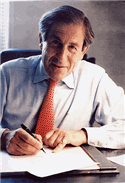
- John Browne Senior Market Strategist, Euro Pacific Capital, Inc.
John Browne is the Senior Market Strategist for Euro Pacific Capital, Inc. Working from the firm’s Boca Raton Office, Mr. Brown is a distinguished former member of Britain's Parliament who served on the Treasury Select Committee, as Chairman of the Conservative Small Business Committee, and as a close associate of then-Prime Minister Margaret Thatcher. Among his many notable assignments, John served as a principal advisor to Mrs. Thatcher's government on issues related to the Soviet Union, and was the first to convince Thatcher of the growing stature of then Agriculture Minister Mikhail Gorbachev. As a partial result of Brown's advocacy, Thatcher famously pronounced that Gorbachev was a man the West "could do business with." A graduate of the Royal Military Academy Sandhurst, Britain's version of West Point and retired British army major, John served as a pilot, parachutist, and communications specialist in the elite Grenadiers of the Royal Guard.
In addition to careers in British politics and the military, John has a significant background, spanning some 37 years, in finance and business. After graduating from the Harvard Business School, John joined the New York firm of Morgan Stanley & Co as an investment banker. He has also worked with such firms as Barclays Bank and Citigroup. During his career he has served on the boards of numerous banks and international corporations, with a special interest in venture capital. He is a frequent guest on CNBC's Kudlow & Co. and the former editor of NewsMax Media's Financial Intelligence Report and Moneynews.com.
Previous Articles by John Browne, Senior Market Strategist, Euro Pacific Capital
|