|
-- Posted Friday, 2 July 2010 | Digg This Article | | Source: GoldSeek.com | | Source: GoldSeek.com
Last week, global attention was focused on Toronto as the G-20 gathered to confront the growing financial and economic worries darkening the global economic horizon. In an irony worthy of Orwell, the representatives of the world's top 20 economies (19 countries plus the European Union) managed to ignore the out-of-control spending contained in Western governments' budgets and instead unite behind a banner that they called "financial responsibility." This is akin to a group of Mafiosi holding a summit on business ethics.
For the sake of indulgence, let us grant that "responsibility" is a relative term. And although the leaders of the EU have committed themselves to massive bailouts of their more profligate members, they are at least showing some remorse after the fact. This stands in sharp contrast to President Obama, who shows no such regret. While the Europeans tried to stick closely to their declared aim of "responsibility," it was clear that the American delegation was working a somewhat different angle.
From my perspective, President Obama and his team had three main goals:
First, the US Administration sought to win wide support for Fed Chairman Ben Bernanke's spend, spend, spend policy. On this front, there appears to be not the slightest daylight between the programs recommended by the Fed and the Treasury. This degree of concord runs contrary to the Fed's supposed independence.
Based on recent statements made by Chairman Bernanke and other influential economists to whom Obama has shown fealty, the United States now seems poised to embark on a second round of stimulus. The latest salvo of weak economic data (unemployment, manufacturing, home sales) greatly increased the likelihood of such an outcome. The American position roughly boils down to: prop up the economy endlessly with boatloads of taxpayer dollars, then worry about debt after the economy can stand on its own. This hypothesis posits that the spending itself will heal the economy and that the politicians will remember their pledge to tackle the debt if it does.
But in matters of financial history the Europeans seem to have clearer memories and fewer illusions.
Led by the Germans, who well recall the infamous Weimar inflation in the 1920's (which brought the Deutsche Mark from 12 to the dollar in 1919 to 4.2 trillion to the dollar by 1923), the Europeans are at least talking about ways to stop the spending before it's too late. The German position has been buttressed by the new Liberal-Conservative Coalition government in the UK. It has long been noted that the UK faces some of the most daunting debt challenges in Europe. With the recent drama in Greece providing a clear cautionary tale, Prime Minister David Cameron has voiced his determination to face the music and make hard cuts. There is early indication that these words will result in an actual austerity budget.
Confronted with this block of resistance, it appears that Obama backed down. The subject was side-stepped. The final agreed communiqué provided only that the G-20 nations have agreed to cut their deficits in half by 2013. It's a weak promise, with a vague timeline; but its intent flies in the face of what the Americans wanted.
Second, Obama was determined to head-off any further calls by the likes of China and Russia for the US dollar to be supplanted as the world's international reserve currency.
The G-20 meetings are conducted in the strictest privacy. This is particularly true of the bilateral meetings between particular members, the most important of which were probably those of China and the United States (the G-2). In these meetings, starting possibly even before the actual G-20 meetings, America achieved two considerable points: China said it would allow the Yuan to float more freely at an unspecified future date, and they agreed not to push publicly again for the US dollar to be removed from its uniquely privileged position as the international reserve currency. How this coup was accomplished is a matter for future historians to uncover, but China's growing internal labor protests may have played a role.
Meanwhile, Russia has been making bolder statements against dollar hegemony. Russian President Dmitry Medvedev has called on central banks to reduce their dollar holdings and for the IMF to create a supranational reserve currency based on a basket of national currencies. Despite China's silence on the issue, central banks appear to be taking Medvedev's cue.
Third, under the guise of climate change spending, the President most probably hoped to push for greater wealth redistribution from the developed to the emerging world. The German government is facing a vote of no-confidence for sending aid to Greece, so it almost goes without saying that discussion of increasing aid outside of the eurozone was met with bewilderment. It appears that for the sake of unity, this plan was also dropped. With the global recession intensifying, dissent in the top ranks of political leadership is rightly to be feared. In the end, a compromise was reached which amounted to little more than an agreement to disagree.
So, it appears Obama was 0 for 3. Despite some progress in Sino-American relations, he did not successfully achieve any of his policy goals at the summit. If anything, the weakness of the final communiqué convinced me that our helmsman hasn't the vaguest clue how to steer the ship.
-- Posted Friday, 2 July 2010 | Digg This Article | Source: GoldSeek.com
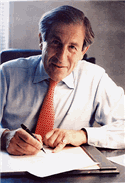
- John Browne Senior Market Strategist, Euro Pacific Capital, Inc.
John Browne is the Senior Market Strategist for Euro Pacific Capital, Inc. Working from the firm’s Boca Raton Office, Mr. Brown is a distinguished former member of Britain's Parliament who served on the Treasury Select Committee, as Chairman of the Conservative Small Business Committee, and as a close associate of then-Prime Minister Margaret Thatcher. Among his many notable assignments, John served as a principal advisor to Mrs. Thatcher's government on issues related to the Soviet Union, and was the first to convince Thatcher of the growing stature of then Agriculture Minister Mikhail Gorbachev. As a partial result of Brown's advocacy, Thatcher famously pronounced that Gorbachev was a man the West "could do business with." A graduate of the Royal Military Academy Sandhurst, Britain's version of West Point and retired British army major, John served as a pilot, parachutist, and communications specialist in the elite Grenadiers of the Royal Guard.
In addition to careers in British politics and the military, John has a significant background, spanning some 37 years, in finance and business. After graduating from the Harvard Business School, John joined the New York firm of Morgan Stanley & Co as an investment banker. He has also worked with such firms as Barclays Bank and Citigroup. During his career he has served on the boards of numerous banks and international corporations, with a special interest in venture capital. He is a frequent guest on CNBC's Kudlow & Co. and the former editor of NewsMax Media's Financial Intelligence Report and Moneynews.com.
Previous Articles by John Browne, Euro Pacific Capital
|